Welcome to the Ophthalmology Department at Wrightington, Wigan and Leigh Teaching Hospitals NHS Foundation Trust (WWL). Our mission is simple: to protect, restore, and improve your vision.
Who We Are
Our team includes:
- Consultant Ophthalmologists
- Associate Specialists & Specialty Doctors
- Ophthalmic Practitioners
- Orthoptists & Optometrists
- Ophthalmic Technicians
- Dedicated Nursing & Support Staff
- Eye Care Liaison Officer (ECLO)
Together, we provide expert care across a wide range of eye conditions, with a focus on glaucoma, retina, cataracts, cornea, paediatric eye conditions, and ocular injections.
Our Services
- Diagnose and monitor glaucoma. Provide ongoing monitoring to track any disease progression and offer individualised care plans based on your type of glaucoma
- Treatment Options
- Eye drops to reduce pressure inside the eye
- Laser therapy (e.g. SLT) to improve fluid drainage
- Surgical procedures such as trabeculectomy for advanced cases
- Specialist Clinics
- Ophthalmic Practitioners-led clinics for follow-up and education
- Orthoptic support for vision testing and management
- Glaucoma monitoring clinics for stable patients
- Referral to care closer to home for patients with stable glaucoma
We offer advanced phacoemulsification and lens replacement procedures. The benefits of choosing Wrightington Wigan and Leigh NHS Trust for your procedure are
- One-stop clinics for assessment and pre-op checks
- Competitive waiting times Find a Hospital - Search for your nearest hospital providing cataract surgery procedures
- Fast-track referrals
Our experienced surgeons also perform complex cataract surgery.
WWL offers a comprehensive high quality Medical Retinal Service.
The team specialise in treating conditions affecting the back of the eye by administration of drugs , injections, and laser treatment.
What conditions do we treat?
The most common retinal disorders which include:
- Age-related macular degeneration
- Diabetic eye disease
- Retinal Vascular occlusions
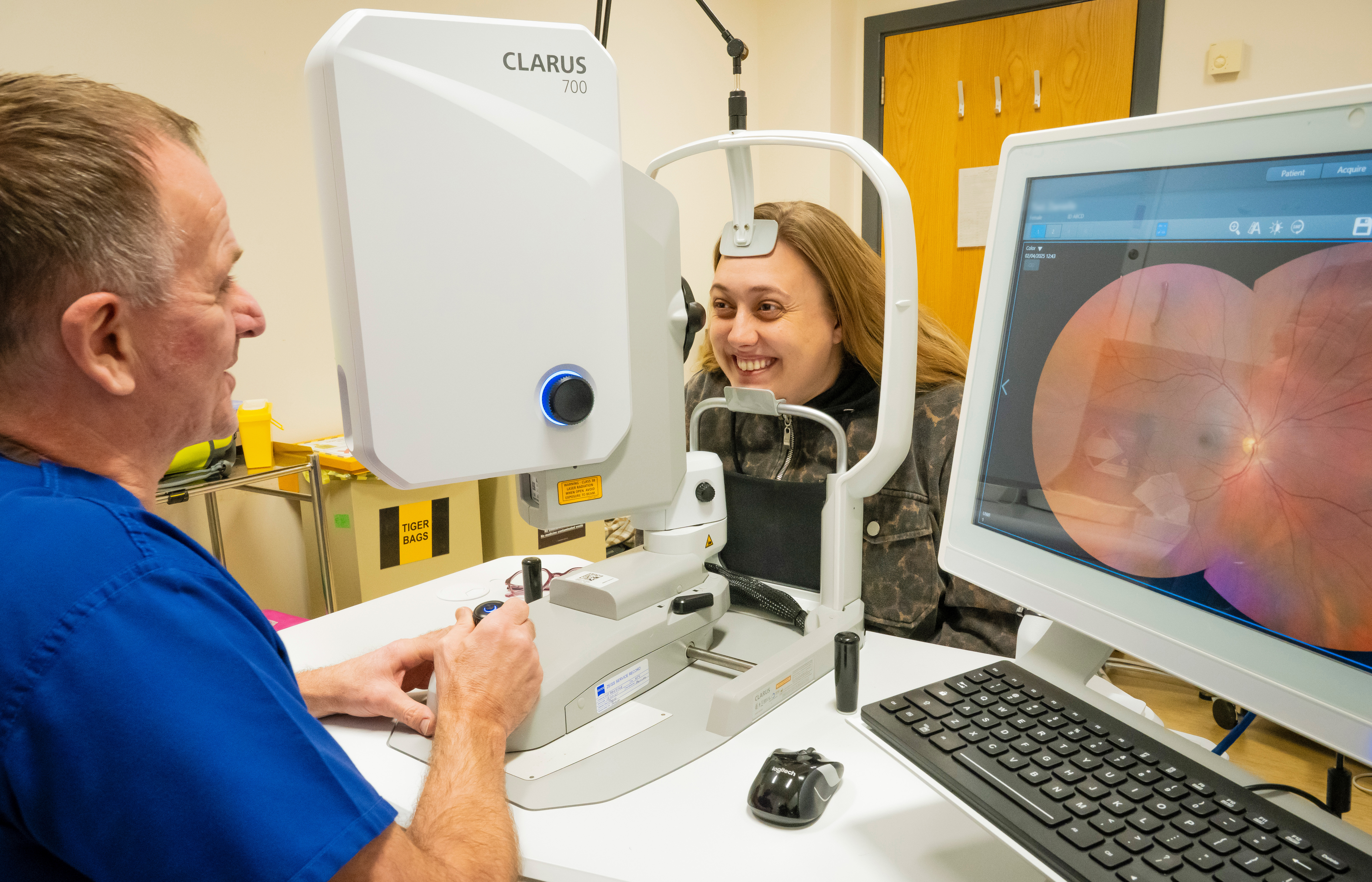
We have the following imaging methods to investigate various eye conditions which include:
Digital fluorescein angiography – this examines the circulation of the retina
Widefield fundus photography – to document retinal pathology
ICG (indocyanine green) angiography – to enhance visualization of the choroidal layer, deep to the retina
Optical Coherence Tomography (OCT) – this allows a cross-sectional image of the retina to be taken
B-scan ultrasonography – to measure the eye and identify abnormalities in the retina when the retina cannot be visualized
What treatments do we offer?
The most common medical retina treatment involves the administration of injections into the back of the eye on a regular basis ( Intravitreal injections ). This service is offered at both Boston House and Leigh Infirmary and includes a “one-stop” service for patients with age-related macular degeneration, and other conditions requiring regular intravitreal injections.
Targeted treatment for retinal conditions using anti-VEGF and steroid injections. Performed in sterile conditions with minimal discomfort.
To learn more about AMD treatment click here.
At our center, we’re dedicated to protecting and nurturing your child’s vision from the very start. Our Paediatric Eye Care Team provides specialised care in a friendly, child-focused environment.
- Retinopathy of Prematurity (ROP) Screening
Early and accurate eye screening for premature babies to detect and treat retinal changes before they affect vision. - National Preschool Vision Screening Programme
Comprehensive eye checks designed to catch potential vision problems early — giving children the best chance for success in school and beyond. - Amblyopia (Lazy Eye) Treatment
Personalised treatment plans using proven techniques to strengthen vision and support normal visual development. - Paediatric Eye Assessments and Non-Surgical Management
Thorough assessments and customised care for a wide range of children’s eye conditions, ensuring healthy vision as they grow.
Our Oculoplasty Service offers specialist care for conditions affecting the eyelids, tear ducts, eye sockets, and surrounding facial areas.
Oculoplasty (or oculoplastic surgery) refers to a range of procedures designed to treat and improve the function and appearance of the areas around the eyes.
Common Conditions We Treat
- Drooping eyelids (Ptosis)
- Inward or outward turning eyelids (Entropion / Ectropion)
- Watery eyes due to tear duct blockage
- Lumps or lesions near the eyes
- Thyroid Eye Disease
- Orbital tumours or trauma
- Artificial eye fitting and socket reconstruction
Treatments We Offer
- Eyelid surgery to correct position and improve vision or comfort
- Tear duct procedures to relieve watering eyes
- Removal of skin lesions near the eyes
- Botulinum toxin injections for conditions like blepharospasm
Most procedures are performed as day cases, ensuring minimal disruption to your daily life.
Our Cornea Service provides expert diagnosis and treatment for conditions affecting the cornea—the clear, dome-shaped surface at the front of your eye.
Common Conditions We Treat
- Keratoconus – thinning and bulging of the cornea, causing distorted vision
- Dry Eye Syndrome – reduced tear production or poor tear quality
- Corneal abrasions and ulcers – injuries or infections that cause pain and blurred vision
- Fuchs’ Endothelial Dystrophy – a condition that causes the cornea to swell and become cloudy
- Herpes Simplex Keratitis – viral infection of the cornea
- Recurrent Corneal Erosion Syndrome – repeated surface damage causing pain and light sensitivity
Treatments We Offer
- Eye drops and medications to manage infections, inflammation, and dryness
- Corneal cross-linking for keratoconus
- Laser treatments for reshaping or repairing the cornea
- Referral to Specialist contact lenses providers for vision correction and protection
ECLOs provide information, emotional support and advice if you have a condition which affects your sight. They can also help while you’re waiting for your diagnosis.
ECLOs provide a listening ear for everyone with a condition affecting their sight, helping you move forward with confidence. They also provide information to help you understand your condition, and details about support and services that are available to help with your everyday life and wellbeing. ECLOs also support family, friends and carers.
You can get help with:
- financial support you may be entitled to
- employment and training
- emotional support
- support for children in education
- living with sight loss and remaining independent
- voluntary organisations and local support groups.
- your ECLO can also tell you about the process of and benefits of certification and registration.
You can be referred to our service by your GP, optician, or another specialist.
Emergency Eye Care
This service is available Monday to Friday 9am – 5pm
If you experience:
- sudden vision loss
- severe eye pain
- flashes or floaters
- or redness/swelling
Please seek urgent care immediately via your local Optician/GP or A+E. Existing patients can contact our Eye Emergency Department for advice on telephone 0300 707 2244 during opening hours and out of hours should contact 111/A&E as appropriate.